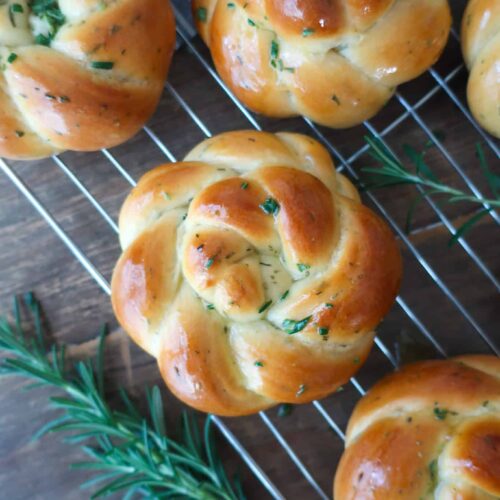
Who knew dinner rolls could be tasty AND pretty? These rosemary challah rolls are soft and packed with fresh flavor, perfect for holiday sides or turned into sandwiches!
Equipment
- Mixer
- Dough Hook Attachment
- Dough Scraper
- Measuring Cups
- Measuring Spoons
- Digital Scale
- Pastry Brush
- Food Thermometer
Ingredients
- 1 ½ tsp dry yeast
- ½ cup warm water
- 2 tbsp warm water
- ⅓ cup beaten egg less than two eggs, save the remainder for egg wash
- ⅓ cup canola oil
- 3 ½ tbsp honey
- 2 ¾ cups bread flour
- 1 tsp salt
- 2 tbsp fresh chopped rosemary
- 2 tbsp salted butter melted
- 1 tsp fresh chopped rosemary
Instructions
- In a mixing bowl fitted with a dough hook, combine your yeast and 1/2 cup plus 2 tbsp of warm water. Leave to sit for five minutes to allow the yeast to bloom
- In a pitcher, combine your beaten egg, canola oil, and honey and give a good mix. Pour half of the mixture into the mixing bowl with the yeast/water
- Add flour to the mixing bowl and set to the lowest speed
- Once mostly combined, add the remainder of your honey mixture to the mixing bowl
- When the dough starts to come together, increase the speed to medium for five minutes
- Scrape down the bowl, then increase to the next highest speed. Mix until the dough is clinging to the hook and cleaning the bowl
- If you need to, scrape the bowl down a final time and mix briefly to bring any remaining pieces together
- On low speed, add your salt and 2 tbsp of rosemary; mix until combined
- Scrape down the bowl and then cover with a towel, leave to rest until doubled in size (roughly 1 hour)
- Press your finger gently into the dough. When the indent you made slowly releases, it’s ready!
- Line two baking sheets with parchment paper
- Using a digital scale and a dough scraper (or a knife), split your dough into eight, 94g balls, cutting from other pieces until all come to an equal weight. Do not tear or pull your dough to do this
- Take each of the eight pieces and degas them one by one, flattening lightly into a rectangle
- Gently roll out each piece of dough into roughly a foot-long cylinder. Lightly flour your surface as needed, so the dough doesn’t tear
- One cylinder at a time, use a rolling pin to flatten your piece of dough, and then with a knife, cut a vertical line from the halfway point down, splitting the dough down the middle. Do not drag your knife
- Twist one piece over the other to form a twisted strand. Cut a vertical line from the halfway point upward now, and twist the remaining dough together
- With one end of your twisted strand in each hand, swing the dough lightly like a jump rope to tighten the strands. Then, holding one end, swirl the dough around it to form a spiral, tucking the last end underneath
- Once you've formed your roll, place it on one of the prepared baking sheets. Shape the rest of your rolls, and split them between the two sheets, leaving a few inches of space between each roll
- Once you’ve formed all of your rolls, cover them with a towel and let them proof until doubled in size (about an hour)
- Preheat your oven to 350°F
- Brush your challah knot with the remainder of your beaten egg, be careful not to let the brush pull at the dough
- Bake on the third shelf down in your oven for 13-15 minutes. You will need to insert a thermometer into the middle hole of the dough - probing through the middle crack, don’t poke through one of your pretty knot lines. The temperature should be between 188°F and 194°F for your dough to be fully cooked.
- Remove from oven and place on a wire rack to cool completely
- Melt 2 tbsp butter with 1 tsp of chopped rosemary and brush over your cooled rolls
- Enjoy!
Notes
*At the current size (94g each), these rolls are a little closer to bun size. If you want smaller rolls, feel free to drop them in size. This will give you more than eight rolls. Be sure to start checking their internal temperature with your thermometer for doneness earlier, since your rolls will be smaller and should cook faster.
*This recipe has been minimally adapted from a recipe I received from Chef Ashley during my patisserie course in Scotland.
